
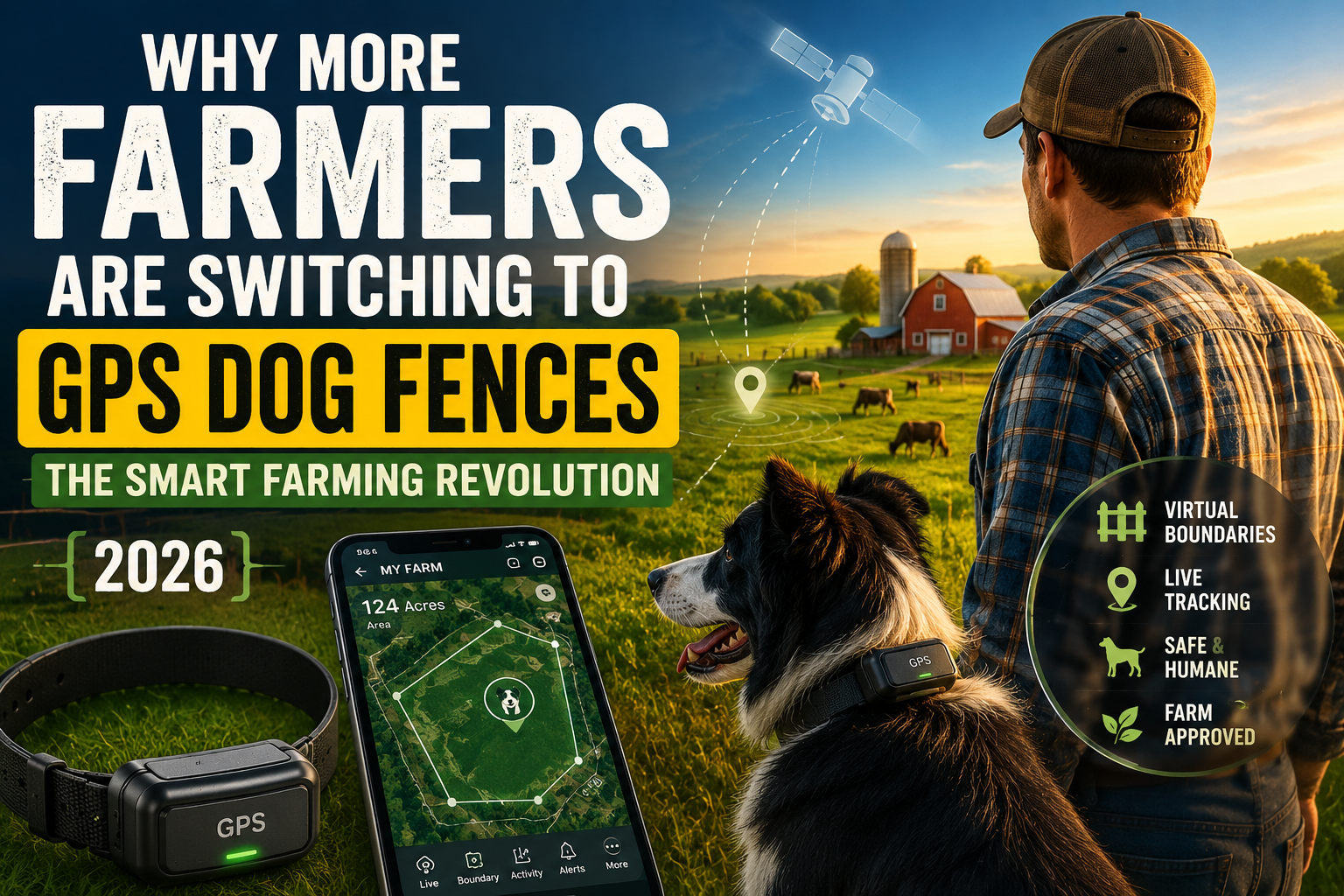

Why More Farmers Are Switching to GPS Dog Fences in 2026
How Smart Technology Is Replacing Miles of Traditional Farm Fencing. The complete guide to satellite-based containment for working dogs, livestock guardians, and active farm companions.
- Introduction
- Why Farmers Are Switching
- How GPS Fences Work
- 10 Reasons to Switch
- GPS vs Traditional
- Real Farm Scenarios
- Problems & Solutions
- Technology Deep Dive
- Are They Worth It?
- Top Picks for 2026
- Common Mistakes
- Weather Performance
- Training Guide
- Farmer Reviews
- Interactive Quiz
- Savings Calculator
- FAQ
- Final Verdict
The Smart Farming Revolution Is Here
For generations, farmers have relied on wooden posts, barbed wire, woven mesh, and electric fencing to keep their working dogs safely within property boundaries. While these traditional solutions remain effective in many situations, they can be expensive to install, time-consuming to maintain, and difficult to adapt as farms grow or change.
Today, a new generation of smart farming technology is transforming how rural property owners protect their dogs. GPS dog fences use satellite positioning instead of buried wires or physical barriers, allowing farmers to create virtual boundaries that can cover everything from a few acres to thousands of acres—all managed from a smartphone.
Whether you own a small homestead, a cattle ranch, a horse farm, or a large agricultural operation, GPS containment systems offer flexibility that traditional fencing simply cannot match. Property boundaries can be adjusted in minutes, working zones can be customized for different tasks, and many systems even provide live location tracking, escape alerts, and activity monitoring.
Most farmers don't use GPS dog fences to replace livestock fencing. Instead, they use GPS systems to keep their dogs safe and still use regular fences for cows, horses, or other animals. The best setup depends on your property, your farm's needs, and what animals you have.
What You'll Discover
- Why traditional farm fencing is becoming more expensive every year
- How GPS dog fences create invisible boundaries without buried wire
- Which GPS systems perform best on farms, ranches, and rural properties
- The real long-term costs compared with traditional fencing
- How GPS collars help protect working dogs while giving them greater freedom
- Common mistakes farmers make when buying GPS containment systems
- Which features matter most for livestock farms, wooded acreage, and large properties
- Whether a GPS dog fence is the right investment for your farm
Why Farmers Are Moving Away From Traditional Fences
For generations, traditional fencing has been the backbone of livestock and farm dog management. Wooden post fences, barbed wire, woven wire, electric fencing, and chain-link barriers have helped define property lines and keep animals where they belong. While these systems remain essential for containing livestock, many farmers are discovering that they are not always the most practical or cost-effective solution for managing dogs—especially on large rural properties.
Rising Fencing Costs
One of the primary reasons farmers are exploring GPS dog fences is the rapidly increasing cost of building and maintaining traditional fencing. A typical farm fence project involves far more than simply purchasing wire. Farmers must also budget for fence posts, concrete, gates, braces, tools, equipment rentals, and labor. On larger properties, installation often requires specialized machinery and several days—or even weeks—of work.
Material Costs
Posts, wire, concrete, gates, and hardware continue to rise in price year over year.
Labor Shortages
Finding reliable agricultural labor has become increasingly difficult in many regions.
Endless Maintenance
Storms, fallen trees, rust, and wildlife damage create a permanent repair cycle.
Zero Flexibility
Moving a physical fence means removing posts, digging new holes, and buying new materials.
The Hidden Costs of Ownership
Beyond installation and repairs, traditional fencing includes several hidden expenses that many farmers overlook until it's too late. When these costs are calculated over ten years, total ownership expenses can be considerably higher than the initial installation cost.
| Expense Category | Frequency | Impact |
|---|---|---|
| Annual maintenance | Yearly | High |
| Replacement gates | Every 3-5 years | Medium |
| Wire repairs | Seasonal | High |
| Vegetation removal | Quarterly | Medium |
| Storm cleanup | After events | Variable |
| Contractor fees | As needed | High |
Instead of constructing new fence lines solely to keep dogs within a property, farmers can create customized containment areas using a smartphone application. Many systems also allow boundaries to be modified as farm operations change, reducing the need for additional installation work.
What Is a GPS Dog Fence?
A GPS dog fence is a wireless containment system that creates virtual boundaries using Global Navigation Satellite Systems (GNSS) instead of buried wires or fixed radio transmitters.
The system typically consists of three main components: a GPS-enabled dog collar, a smartphone application, and satellite positioning technology. Instead of detecting a buried wire or a radio signal from a base station, the collar continuously calculates its location using satellites overhead. When the dog approaches a predefined boundary, the collar delivers a warning—usually a tone, vibration, or static correction—depending on the settings selected by the owner.
How Satellite Positioning Creates a Virtual Fence
Unlike underground systems that rely on buried wire, GPS fences use location coordinates. When setting up the system, you simply open the companion mobile app, walk or draw your property boundary, save the virtual fence, and sync the collar. The collar then compares its real-time position against the stored boundary.
No correction
Tone & vibration
Static correction (if enabled)
Safe return, no extra correction
GPS vs Other Technologies
| Feature | GPS Dog Fence | Traditional Wireless | Underground Fence |
|---|---|---|---|
| Boundary Shape | Custom | Circular | Custom |
| Property Size | Large Acreage | Small-Medium | Limited |
| Buried Wire | None | None | Required |
| Smartphone Setup | Full App | Limited | Limited |
| GPS Tracking | Available | No | No |
| Installation Time | 30 min - 2 hrs | 1-2 hours | 1-3 days |
10 Reasons Farmers Love GPS Dog Fences
As farms become more connected and technology-driven, GPS dog fences are gaining popularity among farmers, ranchers, and rural property owners. Below are the ten biggest advantages driving this growing trend.
No More Buried Wire
Eliminate trenching, wire breaks, and signal repairs. GPS uses satellites instead of physical wire.
Perfect for Large Acreage
From 5 acres to 1,000+ acres. GPS fences scale where traditional wireless systems fail.
Easy Expansion
Purchase neighboring land? Simply redraw the virtual boundary in your app—no construction needed.
Irregular Property Lines
Follow streams, woods, and real boundaries instead of being forced into a perfect circle.
Hours—Not Days—to Install
Charge the collar, install the app, draw the boundary, and begin training. No digging required.
Built for Working Dogs
Ideal for Border Collies, Australian Shepherds, Great Pyrenees, and German Shepherds.
Lower Maintenance
No rust, broken posts, or fallen trees to repair. Just charge the collar and update software.
Live GPS Tracking
View location, receive escape alerts, check battery status, and monitor activity history.
Lower Long-Term Costs
No installation labor, no wire repairs, no trenching. Save thousands over 10 years.
Smart Farming Future
Complements GPS tractors, drone mapping, and smart sensors for a connected operation.
GPS Dog Fence vs Traditional Fence
Choosing the right dog fence isn't just about getting the latest technology. It's about finding what fits your property's size, shape, budget, and future plans. Every fence type has pros and cons.
| Feature | GPS Dog Fence | Traditional Physical | Underground |
|---|---|---|---|
| Installation | ⭐⭐⭐⭐⭐ | ⭐⭐☆☆☆ | ⭐☆☆☆☆ |
| Large Property Support | ⭐⭐⭐⭐⭐ | ⭐⭐⭐☆☆ | ⭐⭐☆☆☆ |
| Property Expansion | ⭐⭐⭐⭐⭐ | ⭐☆☆☆☆ | ⭐☆☆☆☆ |
| Maintenance | ⭐⭐⭐⭐☆ | ⭐⭐☆☆☆ | ⭐⭐☆☆☆ |
| Smartphone Control | ✅ Yes | ❌ No | ❌ Limited |
| GPS Tracking | ✅ Available | ❌ No | ❌ No |
| Custom Boundaries | ✅ Yes | Construction required | ✅ Yes |
GPS dog fences are designed to contain dogs—not livestock. Many farmers achieve the best results by combining traditional fencing for cattle, horses, or sheep with GPS-based containment for working dogs. This hybrid approach can reduce maintenance while preserving the security of physical livestock enclosures.
Real Farm Scenarios
Every farm is different. A GPS dog fence that's great for a small 5-acre hobby farm might not work as well for a 500-acre cattle ranch. Here are real-world examples:
🏡 Small Hobby Farm (1–10 Acres)
Challenge: Dogs chasing wildlife, crossing property lines, entering gardens.
Solution: Virtual boundaries following property shape with exclusion zones around gardens and ponds.
Best Features: Easy mobile setup, custom shapes, escape alerts.
🐄 Large Ranch (50–500+ Acres)
Challenge: Dogs roaming too far, difficult fence maintenance, irregular boundaries.
Solution: Extensive virtual boundaries adjusted seasonally as grazing areas rotate.
Best Features: Large acreage support, long battery life, live tracking.
🐎 Horse Farm
Challenge: Dogs entering riding arenas, chasing horses, visitors leaving gates open.
Solution: Exclusion zones around arenas and paddocks with flexible patrol areas.
Best Features: Exclusion zones, quiet vibration mode, fast boundary editing.
🥛 Dairy Farm
Challenge: Dogs entering milking facilities, heavy vehicle traffic, multiple work areas.
Solution: Separate dogs from high-traffic operational areas while allowing barn patrols.
Best Features: Adjustable safe zones, escape notifications, activity monitoring.
🐑 Sheep & Goat Farm
Challenge: Predator patrol, rotational grazing, temporary fencing needs.
Solution: Flexible grazing boundaries that move with the herd seasonally.
Best Features: Easy seasonal adjustments, live location tracking.
🌲 Hunting Property
Challenge: Training dogs over large wooded properties without physical barriers.
Solution: Define training areas while monitoring movement across hundreds of acres.
Best Features: GPS tracking, flexible training areas, offline maps.
Common Problems Farmers Face (And How GPS Fences Help)
Farmers solve problems every day, including keeping working dogs safe. Whether you have cattle, poultry, or lots of land, farm dogs deal with challenges that most city or suburban pets never face.
Dogs Keep Escaping
Receive escape alerts, track location in real-time, and customize correction levels for each dog.
Dogs Chase Livestock
Create exclusion zones around calving pens, poultry houses, and horse arenas to prevent stress and injury.
Boundaries Keep Changing
Update virtual boundaries in minutes when pastures rotate, new fields are added, or equipment yards move.
Endless Fence Repairs
No physical dog fence means no storm damage, broken posts, or fallen trees to repair for containment.
Dogs Disappear During Work
Live tracking shows exactly where working dogs are, even when they're herding hundreds of yards away.
Dogs Enter Dangerous Areas
Virtual no-go zones around machinery, wells, chemical storage, fuel tanks, and ponds.
GPS Fence Technology Explained
Modern GPS dog fences may seem like magic at first glance—there are no buried wires, no visible barriers, and no base stations defining a physical perimeter. Yet your dog can learn where the invisible boundary begins and ends.
The Four Core Components
Every GPS dog fence consists of four primary components working together:
GPS, GLONASS, Galileo, and BeiDou constellations provide positioning.
Receives signals, calculates position, and delivers warnings.
Draw boundaries, adjust settings, and track your dog live.
Custom polygon stored in memory that defines the safe zone.
How Accurate Are GPS Dog Fences?
Accuracy depends on several factors including satellite visibility, terrain, tree canopy, collar hardware, software algorithms, weather conditions, and nearby structures. Premium systems that use multiple satellite constellations and advanced processing generally provide more consistent positioning than entry-level models.
| Environment | Performance | Notes |
|---|---|---|
| Open Fields | ⭐⭐⭐⭐⭐ Excellent | Best possible conditions |
| Rolling Hills | ⭐⭐⭐⭐☆ Very Good | Minor signal variation |
| Wooded Areas | ⭐⭐⭐☆☆ Good | Depends on canopy density |
| Metal Buildings | ⭐⭐⭐☆☆ Good | Large structures may affect reception |
| Deep Valleys | ⭐⭐☆☆☆ Fair | Reduced satellite visibility |
Many modern collars communicate with GPS (United States), GLONASS (Russia), Galileo (European Union), and BeiDou (China). By combining signals from multiple satellite networks, collars can determine their position more accurately, even when some satellites are temporarily blocked by trees, hills, or buildings.
Are GPS Dog Fences Worth It?
If you're considering a GPS dog fence, you're probably asking one simple question: "Is it actually worth the investment?" The answer depends on your property, your dog's role, and your long-term goals.
When a GPS Dog Fence Is Worth It
- You own more than 5 acres
- You have irregular property lines
- You frequently expand or modify your land
- You have working farm dogs
- You want GPS tracking capabilities
- You prefer smartphone control
- You don't want to bury thousands of feet of wire
- You need flexible exclusion zones
When It May Not Be Worth It
- You need a physical barrier for livestock containment
- Your property is extremely small (under 1 acre)
- You don't have time for boundary training
- Your property has significant GPS signal challenges
- You prefer a completely maintenance-free system
🧮 See Your Potential Savings
Use our interactive calculator below to compare 10-year ownership costs between traditional fencing and a GPS dog fence system.
Open Savings CalculatorTop GPS Dog Fences Farmers Buy in 2026
Choosing the right GPS dog fence can be overwhelming. Today's market includes everything from entry-level containment systems to premium smart collars with live tracking, activity monitoring, and customizable virtual boundaries. We've grouped the best systems by use case.
- 10–1,000+ acres support
- Optional live tracking
- Multiple boundary profiles
- Strong mobile app
- 1–500 acres support
- Live tracking & activity monitoring
- Smart training programs
- Multiple correction options
- 5–100 acres support
- Smartphone setup
- Trusted brand
- Budget-friendly
- Large property coverage
- Offline mapping
- Training capabilities
- No subscription required
- Very large properties
- Multi-dog support
- Rugged design
- Professional-grade tracking
- Medium farm support
- Training focus
- Good battery life
- Easy operation
Common Mistakes Farmers Make
Buying a GPS dog fence is only the first step. The biggest difference between farmers who love their system and those who become frustrated often comes down to proper setup, realistic expectations, and consistent training.
Skipping Training
The collar reinforces training—it doesn't replace it. Most dogs need 2-4 weeks of structured boundary walks.
Boundaries Too Close to Roads
Always create a wide safety buffer between virtual boundaries and highways, busy roads, or railroad tracks.
Ignoring Battery Levels
A dead collar cannot contain your dog. Create a regular charging schedule—many farmers charge overnight.
Expecting GPS to Replace Livestock Fencing
GPS dog fences contain dogs—not cattle, horses, or sheep. Physical fencing remains essential for livestock.
Ignoring Terrain
Dense forests, deep valleys, and large metal buildings affect GPS performance. Always test before unsupervised use.
Buying Based Only on Price
Compare GPS accuracy, battery life, coverage, durability, and support—not just the purchase price.
📅 The First 30 Days Timeline
Charge collar, install app, draw boundary, walk perimeter with dog, introduce tone only.
Practice boundary walks twice daily. Reward your dog for turning back. Keep sessions short and positive.
Allow short off-leash sessions under supervision. Observe responses to warning zones.
Gradually increase freedom. Test different areas. Continue reinforcing good behavior.
How Weather Affects GPS Dog Fence Performance
One of the biggest questions farmers ask before buying a GPS dog fence is: "Will it still work during rain, snow, storms, or extreme weather?" The short answer is yes—most modern GPS dog fences are designed to operate in a wide range of outdoor conditions.
| Weather | GPS Performance | Battery Impact | Action Needed |
|---|---|---|---|
| ☀️ Sunny | ⭐⭐⭐⭐⭐ Excellent | Normal | No action needed |
| ☁️ Cloudy | ⭐⭐⭐⭐⭐ Excellent | Normal | No action needed |
| 🌧️ Rain | ⭐⭐⭐⭐☆ Very Good | Slight | Dry collar after use |
| ⛈️ Thunderstorms | ⭐⭐⭐⭐☆ Very Good | Normal | Supervise outdoor activity |
| ❄️ Snow | ⭐⭐⭐⭐☆ Very Good | Moderate | Check battery more often |
| 🌫️ Fog | ⭐⭐⭐⭐⭐ Excellent | Normal | No special adjustments |
| 🌬️ High Wind | ⭐⭐⭐⭐⭐ Excellent | Normal | Watch for distractions |
| 🧊 Freezing Temps | ⭐⭐⭐⭐☆ Very Good | Faster drain | Charge more frequently |
Cold temperatures can reduce battery efficiency and shorten operating time. Fully charge before long outings, store collars indoors when not in use, and remove packed ice from contact points.
GPS Dog Fence Training Guide
Buying the best GPS dog fence is only half the equation. The real key to success is proper training. A GPS fence does not automatically teach your dog where the invisible boundary is.
Before You Start — Checklist
- GPS collar fully charged
- Proper collar fit verified
- Boundary created in app
- Boundary tested on foot
- Safe buffer from roads established
- High-value treats prepared
- Quiet training environment selected
4-Week Training Timeline
Week 1 — Boundary Introduction
Goal: Teach your dog where the invisible boundary begins.
- ✓ Walk boundary on leash daily
- ✓ Let dog hear warning tone
- ✓ Turn around immediately
- ✓ Reward with praise and treats
- ✓ 10-15 min sessions, 2-3x daily
Week 2 — Controlled Learning
Goal: Dog begins understanding the warning zone.
- ✓ Walk toward multiple boundary points
- ✓ Let warning tone activate
- ✓ Encourage dog to return
- ✓ Add mild distractions (toys, family)
- ✓ 15-20 min sessions, twice daily
Week 3 — Supervised Freedom
Goal: Limited off-leash sessions under close watch.
- ✓ Stay nearby during sessions
- ✓ Watch body language closely
- ✓ Reward correct decisions
- ✓ Introduce farm scenarios (barns, equipment)
- ✓ 20-30 min sessions
Week 4 — Real Farm Life
Goal: Normal farm routines with gradual independence.
- ✓ Feeding animals together
- ✓ Walking fields
- ✓ Equipment checks
- ✓ Patrol routes
- ✓ Continue positive reinforcement
Border Collies learn quickly but need mental stimulation—short sessions work best. Great Pyrenees are independent thinkers requiring extra patience and repetition. German Shepherds respond excellently to routine. Labradors are food-motivated and learn rapidly with frequent rewards.
Real Farmer Experiences
One of the best ways to evaluate a GPS dog fence isn't by reading the specifications—it's by learning from people who use them every day. Here are representative experiences from rural communities.
320-acre cattle ranch, Texas
"Our Border Collies were constantly following cattle beyond the working pasture. Maintaining separate fencing just for them wasn't practical. With GPS boundaries, we made seasonal adjustments in minutes instead of days."
40-acre horse farm, Kentucky
"Our Australian Shepherd loved running into the riding arena during lessons. We created a virtual exclusion zone around the arena through the app. Problem solved in five minutes—no construction needed."
180-acre dairy farm, Wisconsin
"The dog kept wandering near milk trucks and loading areas. We added exclusion zones around the processing area through the mobile app. Improved safety without restricting his ability to patrol the barns."
Which GPS Dog Fence Is Right for Your Farm?
One GPS dog fence doesn't fit every property. A system that's perfect for a 10-acre hobby farm may not be the best choice for a 500-acre cattle ranch. Take this 10-question interactive quiz to discover your best match.
Farm Fence Savings Calculator
Discover how much you could save over 10 years by switching from traditional fencing to a GPS dog fence system. Enter your property details below.
💰 Calculate Your 10-Year Ownership Cost
Adjust the values to match your farm's situation
Frequently Asked Questions
Everything farmers want to know about GPS dog fences. Click any question to expand the answer.
For many farmers, especially those with medium to large rural properties, GPS dog fences offer flexible virtual boundaries without burying wires. They work best when combined with proper training and are particularly useful for changing farm layouts.
Many GPS systems perform well on properties ranging from a few acres to several hundred acres. Always check the manufacturer's supported coverage area before purchasing. They excel on properties over 5 acres where traditional wireless systems struggle.
No. GPS dog fences are designed to contain dogs—not cattle, horses, sheep, goats, or other livestock. Physical fencing remains necessary for livestock management and property security. Many farmers use a hybrid approach.
Not always. Some systems offer optional subscriptions for live tracking or cloud features, while others provide core containment functionality without recurring fees. Models like the Dogtra Pathfinder2 and Garmin Alpha Series do not require subscriptions for basic GPS tracking.
The collar uses satellite positioning (GPS, GLONASS, Galileo, BeiDou) to compare the dog's location against a virtual boundary created in the mobile app. When the dog approaches the boundary, the collar delivers progressive warnings: tone, then vibration, then optional static correction.
Accuracy depends on the system, satellite reception, terrain, and environmental conditions. Open rural areas generally provide the most consistent performance. Premium systems using multiple satellite constellations offer the best accuracy. Always maintain a safety buffer around hazards.
Dense tree cover may reduce positioning consistency on some systems, although many modern collars continue to function in lightly wooded areas by connecting to multiple satellite networks. Test your specific property before relying on the system in heavily forested areas.
Normal rain, clouds, and fog typically have little effect on GPS signals. Extreme conditions are more likely to affect battery life than GPS positioning. Dense forests, steep valleys, and large structures have more impact than weather.
Absolutely. Training is essential for helping dogs understand and respect virtual boundaries. Most dogs learn basic boundary awareness within 2-4 weeks with consistent practice. The collar reinforces training—it does not replace it.
Many premium GPS fence systems support multiple collars managed through a single mobile app. Each dog can have individualized settings for correction levels, activity monitoring, and boundary responses.
Battery life varies by model, tracking frequency, and usage. Most premium collars last 1-3 days with active GPS tracking, while basic containment modes can extend battery life significantly. Cold weather reduces battery performance.
Many premium models are water-resistant or waterproof with IP67 or IP68 ratings, meaning they can withstand rain, mud, and occasional submersion. Always verify the specific product's IP rating before purchasing for wet farm environments.
Common causes include incomplete training, poor collar fit, low battery, distracting environments, or boundary placement that needs adjustment. Return to structured training, verify collar fit, review settings, and minimize distractions until your dog responds reliably.
Many GPS fence systems support virtual no-go areas around ponds, barns, gardens, equipment yards, or livestock areas. These exclusion zones can often be created and modified directly through the companion mobile app in minutes.
Expecting technology to replace training. The most successful owners combine proper setup, positive reinforcement, routine maintenance, and realistic expectations. A GPS fence is a management tool—not a replacement for responsible supervision.
Which GPS Dog Fence Should You Buy in 2026?
After comparing today's leading GPS dog fence systems based on GPS accuracy, farm coverage, battery life, app experience, durability, training features, subscription costs, customer satisfaction, and long-term value, here are our final recommendations.
🏆 Best Overall for Farmers: SpotOn GPS Fence
SpotOn consistently delivers one of the best combinations of excellent GPS accuracy, large property support, flexible custom boundaries, strong mobile app, live tracking, and easy virtual fence creation. It remains our top recommendation for 2026.
| Category | Winner | Why It Won |
|---|---|---|
| 🏆 Best Overall | SpotOn GPS Fence | Balanced performance, accuracy, and flexibility |
| 💰 Best Budget | PetSafe Guardian GPS | Good value for smaller properties |
| 🚜 Best Large Farm | SpotOn GPS Fence | Excellent support for expansive rural properties |
| 🤠 Best Ranch | Garmin Alpha Series | Professional-grade tracking and durability |
| 👑 Best Premium | Halo Collar 5 | Advanced app experience and guided training |
🛒 Ready to Choose the Right GPS Dog Fence?
Compare today's top-rated GPS dog fences, review current pricing, and choose the model that best fits your farm, your dogs, and your budget.
Compare Best GPS Dog Fences on AmazonA GPS dog fence is more than a containment system—it's a management tool that can simplify life on farms, ranches, and rural properties. The best results come from combining the right product with thoughtful boundary planning, consistent training, and regular maintenance. By matching the system to your property and your dog's needs, you'll improve safety, flexibility, and day-to-day farm operations while getting the most value from your investment.