
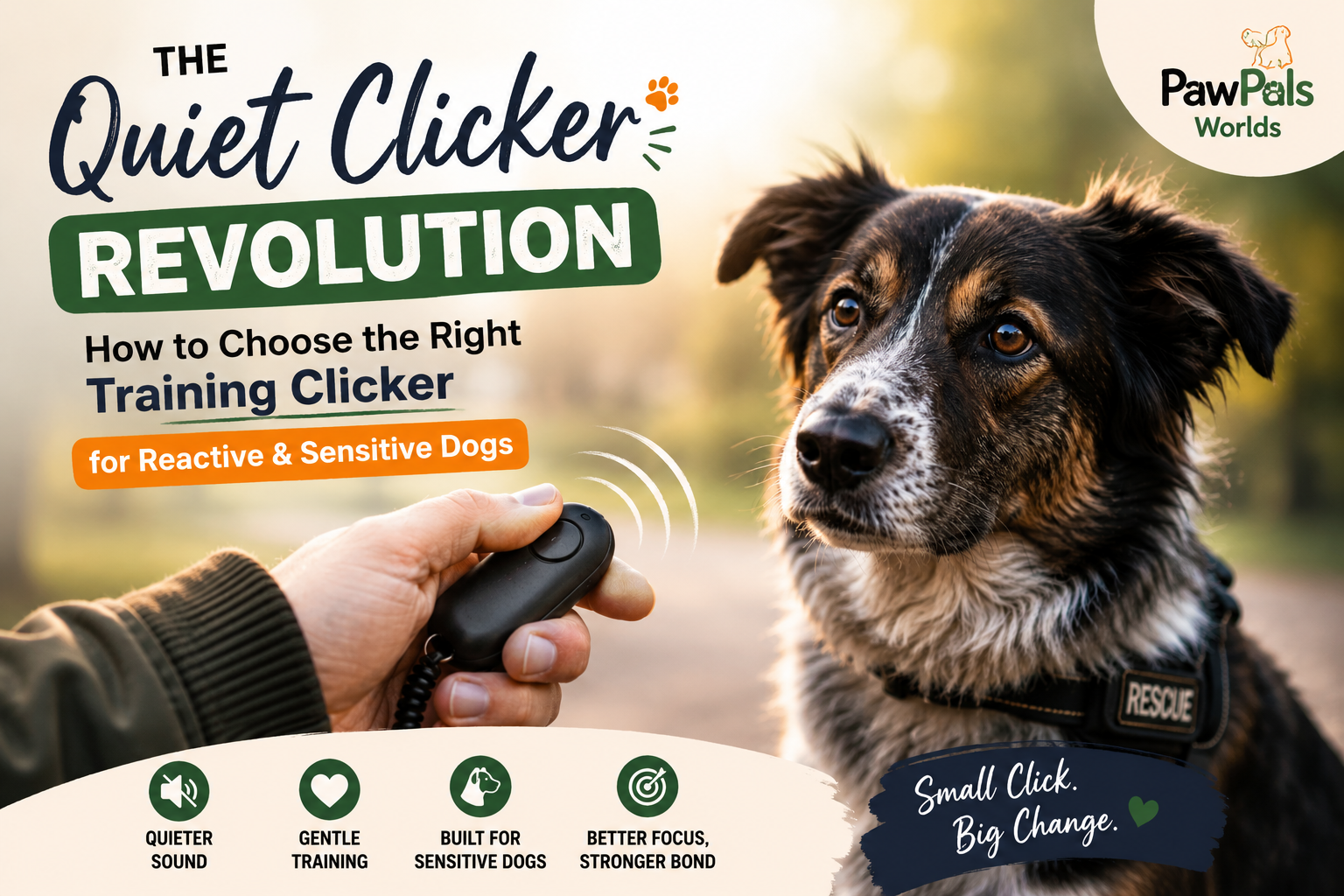

The Quiet Clicker Revolution: How to Choose the Right Training Clicker for Reactive & Sensitive Dogs
Why the Wrong Clicker Can Set Back Your Dog's Progress — and the 12 Hidden Factors That Actually Matter
Now picture this: You're standing in a public park, leash wrapped around your wrist, heart hammering. A standard box clicker goes CLICK — sharp, metallic, cutting through the air like a knife — and your already stressed dog spirals. Ears pinned. Hackles up. The leash goes taut. Other owners stare. You feel the familiar heat of shame creep up your neck.
Here's the truth nobody told you: It's not just a tool. It's a bridge of communication — and when it breaks, trust goes with it.
For dogs with reactive or fearful nervous systems, a single startling acoustic event can undo weeks of careful counter-conditioning. The clicker that was supposed to accelerate learning becomes the very thing that confirms their worst fear: the world is unpredictable, and even my human can hurt me.
But it doesn't have to be this way.
| The Core Problem | The Solution | Your Quick Win |
|---|---|---|
| 90% of commercial clickers are built for confident working dogs, delivering sound levels above 80 dB that trigger fear in sensitive dogs. | Switching to a low-decibel, soft-action button clicker preserves your timing precision without overloading your dog's nervous system. | Take the 3-question sensitivity diagnostic below to identify your dog's exact decibel threshold instantly. |
Section 1: The Invisible Problem — Reactivity vs. Sensitivity
Why Your Reactive Dog Isn't "Bad" — They're Overwhelmed
Let's get one thing straight before we talk gear: barking and lunging look like aggression, but 90% of the time, it's fear wearing a scary mask.
When a reactive dog encounters a trigger — another dog, a stranger, a skateboard — their nervous system doesn't just get "annoyed." It hijacks their entire brain. Cortisol spikes. The sympathetic nervous system floods their body with adrenaline. Their ability to process information, make choices, or even hear your voice drops through the floor. This isn't disobedience. It's biology.
Research on canine reactivity consistently shows that dogs displaying aggressive-looking behaviors often have underlying fear or anxiety driving the response. One study examining training classes for adolescent dogs found that reactive behaviors like vocalization and leash pulling decreased when owners actively engaged their dogs with positive reinforcement — but only when the training environment felt safe enough for the dog to remain under threshold. Without that safety baseline, no learning happens.
Why the Wrong Gear Is Like Pouring Gas on a Fire
If your dog flinched at the click, you didn't fail. The clicker failed your dog.
Here's what most trainers won't say out loud: a startling acoustic event doesn't just "startle" a sensitive dog. It creates a micro-trauma — a tiny fracture in the trust you've spent weeks building. Each loud click near a reactive dog's ears is a mini-explosion that tells their amygdala: danger is everywhere, even from the person I love.
Bioacoustic research shows that mechanical clickers produce what's called an impulse sound — a noise that reaches full intensity in under 12 milliseconds. In mammals, sounds with this rapid onset at volumes around 80–90 dB can trigger the acoustic startle response. Even "quiet" mechanical clicks retain this sudden onset characteristic, which is why some fearful dogs cannot habituate to them — they become sensitized instead.
The result? Your counter-conditioning protocol unravels. Your dog begins associating training sessions with anxiety. And you start wondering if positive reinforcement "just doesn't work" for your dog. It does. You just need the right bridge.
Section 2: Interactive Noise-Sensitivity Diagnostic
Before you buy anything, let's diagnose your dog's acoustic profile. Answer these three questions honestly:
🐾 Interactive Diagnostic: Find Your Dog's Acoustic Threshold
Section 3: The Science of the Click
Why Timing Beats Treats Every Time
Imagine learning piano. Every correct note makes a light flash instantly. No light? You have no idea what you did right. The click is the light; the treat is the applause that comes after.
This is marker-based learning in its simplest form. A marker (the click) bridges the gap between the behavior and the reward. Without it, your dog has to guess which micro-moment earned the treat — and when they're reactive, their guessing game is already overloaded with environmental stress.
A groundbreaking 2025 study published in Frontiers in Veterinary Science tested 28 detection dogs, half trained with a clicker marker and half with reward-only delivery. The results were striking: clicker-trained dogs completed their training in fewer trials, performed alert responses with greater physical precision, located targets more accurately in novel environments, and showed significantly greater resistance to extinction when primary rewards were withheld.
The researchers concluded that the marker itself acquires reinforcing properties — triggering dopamine release similar to actual reward receipt — while eliminating the confusion that delays learning.
Why Verbal Praise Fails Under Stress
"But I just say 'Yes!' — isn't that the same thing?" Not for a reactive brain. Here's why:
- Pitch shifts: Your voice changes when you're stressed, excited, or frustrated. Your dog hears that emotional bleeding.
- Slower delivery: A verbal "Yes" takes ~150 milliseconds. A click takes 10–20 milliseconds. In dog training, that's an eternity.
- Inconsistency: You say "Yes," "Good boy," "Nice," and "That's it" interchangeably. A click is one sound, one meaning, every single time.
5 Ways Marker Training Rewires a Reactive Brain
- Catches Micro-Moments of Calm: That deep breath before the lunge? The soft eye contact instead of a hard stare? The click marks it instantly — before reactivity wins.
- Improves Focus Around Triggers: The "Look at That!" (LAT) game depends on precise timing. The click tells your dog: "Noticing the trigger calmly is the winning move."
- Eliminates Ambiguity: One sound. One precise meaning. Zero emotional confusion.
- Builds Micro-Wins: Rapid confidence stacking through clear feedback loops.
- Supercharges Desensitization: Accelerates Pavlovian counter-conditioning: trigger appears → I stay calm → click → treat → good things happen.
Want to master distance control around triggers? Read our complete guide: How to Implement the 'Look at That' Game for Leash Reactivity.
Section 4: The 12-Factor Buyer's Bible for Sensitive Dogs
1. Click Decibels & Volume: Loud Isn't Brave — It's Brutal
Case Study: Sarah & Milo the Rescue Greyhound: Sarah adopted Milo, a retired racing Greyhound with severe noise phobia. She bought a standard box clicker rated at 85 dB — the same volume as a passing freight train at close range. One click in her quiet living room, and Milo bolted to his crate, trembling. It took three weeks of trust-rebuilding before he would take treats from her hand again. One click undid a month of progress.
The Rule: For sensitive or reactive dogs, target under 65 dB. For context:
- Standard box clicker: 80–90 dB (🔴 Avoid)
- Soft button clicker: 65–75 dB (🟡 Moderate)
- Whisper/soft clicker: 50–60 dB (🟢 Best Choice)
Top Pick: The Karen Pryor i-Click Original is specifically engineered to be quiet enough for sound-sensitive animals while remaining audible to your dog. At roughly 60 dB, it hits the sweet spot.
2. Button Pressure & Resistance: The Speed of Trust
Stiff metal tongues in cheap clickers cause delayed clicks. Look for a soft-action button with minimal resistance.
Top Pick: The i-Click's low-resistance button requires minimal pressure for rapid actuation.
3. Ergonomics & Hand Fatigue
Reactive dog training is a three-handed job (leash, clicker, treats). Your clicker must fit in your palm, allow one-handed thumb use, and prevent cramping.
4. Retention Systems: Wrist Coils vs. Finger Loops
Wrist coils keep the clicker accessible even if you drop it during sudden lunges.
Top Pick: The StarMark Pro-Training Clicker with Wrist Band combines a soft click with a secure wrist strap.
5. Acoustic Consistency: The Pitch Problem
Inconsistent pitch confuses anxious dogs. Stick to high-quality brands with uniform springs.
6. Build Quality & Weatherproofing
Look for ABS plastic housing and sealed button mechanisms that survive rain and drops.
7. One-Handed & Blind-Thumb Operation
Click without looking—your eyes must stay on your dog to spot micro-stress signs (lip licking, ear pinning, whale eye).
8. Multi-Dog Color & Pitch Coding
Use distinct clickers/colors if you train a reactive dog alongside a confident dog.
9. Pocket Portability & Low Profile
It must fit into a treat pouch or pocket easily so you take it on every walk.
10. Environmental Adaptability Matrix
| Environment | Noise Level Needed | Best Clicker Type | Affiliate Pick |
|---|---|---|---|
| Quiet home | Very low (50–60 dB) | Whisper/soft clicker | i-Click Original |
| Backyard | Low (60–65 dB) | Soft button clicker | PetSafe Clik-R |
| Public park | Medium (65–70 dB) | Soft button + muffling | i-Click + Pocket Technique |
11. Reading Micro-Signs of Noise Overload
If you see lip licking, ear pinning, or sudden scratching, stop clicking. Muffle the sound behind your back or switch to a visual marker.
12. Budget vs. Quality: The $3 Mistake That Costs Months
A $3 multi-pack is no bargain if it sets back training. Investing in a $12–$15 quality clicker protects your counter-conditioning progress.
Section 5: Clicker Types Decoded & Comparison
| Clicker Type | Noise Level (dB) | Ideal For | Reactivity Risk | Top Recommendation |
|---|---|---|---|---|
| Box Clicker | High (80–90 dB) | Outdoor obedience, confident dogs | 🔴 High Risk (Avoid) | Standard Box |
| Button Clicker | Medium (70–75 dB) | Standard training, calm settings | 🟡 Moderate | PetSafe Clik-R |
| Soft / Whisper Clicker | Low (50–60 dB) | Sensitive, fearful, reactive dogs | 🟢 Best Choice | Karen Pryor i-Click |
Audio Module: Acoustic Decibel Simulation
Click below to simulate how different clicker volumes sound relative to each other:
Section 6: Common Mistakes, Edge Cases & Safety
The 6 Deadly Buying Mistakes
- Prioritizing volume over emotional sensitivity.
- Ignoring hand ergonomics during multi-item leash holding.
- Buying ultra-cheap multi-packs with inconsistent acoustic pitch.
- Forgetting leash-management mechanics and drop safety.
- Expecting a clicker to "fix" reactivity without a proper training protocol.
- Failing to prepare an emergency "muffled click" or pocket-click strategy.
The Aggressive Dog Question: Can You Clicker Train a Dog Who Bites?
Yes — with safety protocols:
- Muzzle-positive pairing: Train your dog to love their basket muzzle before introducing marker work.
- Barrier training: Use exercise pens or baby gates during early sessions.
- Professional support: Consult a certified behaviorist (IAABC or CCPDT) if bite history exists.
Section 7: FAQs & Interactive Pre-Purchase Checklist
Frequently Asked Questions
Q: Can I just use a verbal marker like "Yes!"?
A: Yes, but clickers offer higher consistency and zero emotional variation. Verbal praise takes ~150ms while a click takes 10-20ms. For precise micro-moment timing, clickers excel.
Q: Should every single click be followed by a treat?
A: Absolutely. The click is an unbreakable contract. Withhold treats and you extinguish the neural connection.
Q: What if my dog still flinches at a soft clicker?
A: Muffle the click in your pocket or transition to a silent visual marker (like a flashlight flash or thumbs-up).
Interactive Pre-Purchase Checklist
Verify each requirement before buying:
Section 8: Conclusion & Call to Action
Your reactive dog isn't broken. They are just trying to navigate a world that feels too loud. The right clicker says: "I hear you. You're safe. And you got it right."
Ready to Upgrade Your Training?
Give your dog the gentle communication tool they deserve.
Shop Quiet Clickers on Amazon →
Last Updated: July 2026 | Affiliate Disclosure: PawPals Worlds participates in the Amazon Associates Program. Links include our tag pawpalsworlds-20.